
Circular economy has become the language we use for keeping products and materials in use for longer. But for individual businesses, it isn’t always the most useful place to start.
The term brings together two different ideas: the economy – a complex system of businesses, people, markets, infrastructure and institutions – and circularity – the principle of keeping products, materials and resources at their highest value for as long as possible.
That distinction matters.
No individual business can make the economy circular. What it can do is make better decisions about the resources, products and materials within its influence.
And that puts circularity somewhere much more practical: inside business strategy.
From circular economy to sustainable business practice
Rather than treating circularity as a separate sustainability programme, businesses can think about resource circularity as one part of good, long-term business practice.
A sustainable business still needs to make a profit. It needs to remain competitive, respond to customers, manage risk and invest in its future. At the same time, it needs to think about the resources it depends upon, the emissions it creates, the people within its value chain and its relationship with nature.
These aren’t necessarily competing agendas. Increasingly, they are different dimensions of the same question:
How do we create and retain value over the long term?
Seen this way, circularity becomes less about pursuing an abstract vision of a circular economy and more about understanding where resources and value are entering, moving through and leaving a business – and whether they could be managed differently.
Start with value, not waste
One of the most useful shifts is to stop thinking about circularity primarily as a waste problem.
By the time something becomes waste, much of its value may already have been lost.
Instead, look upstream at different parts of the value chain and ask questions about where and what value could be saved.
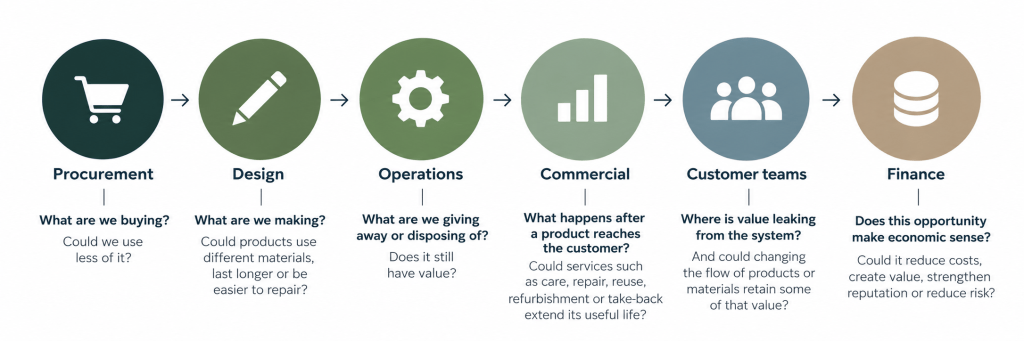
This is also where familiar principles such as the waste hierarchy become useful business tools rather than simply environmental frameworks.
Circularity is an operational question
This also changes who needs to be involved.
Resource circularity isn’t something a sustainability team can deliver alone.
Procurement influences what enters the business. Design determines what products are made from and how long they can remain useful. Operations determine how efficiently resources are used. Commercial teams understand where value can be created. Customer teams understand which services and experiences people will actually use. Finance determines whether an opportunity makes economic sense.
That means some of the most valuable circular opportunities may not initially look like sustainability initiatives at all.
They might be a redesigned process that uses less material. A repair service that strengthens the customer relationship. A packaging change that removes unnecessary cost. A way of recovering products that still contain value. Better information that allows teams to make different purchasing decisions.
The question isn’t simply “How do we become more circular?”
A more useful question might be:
“Where are we losing resources and value today – and what could we do differently?”
Sustainability doesn’t replace business strategy
There can be a tendency to frame sustainable business as a choice between profit and impact. That isn’t particularly helpful either.
Profit, competitive advantage and customer experience still matter.
The challenge is to make decisions with a longer-term understanding of value, resources, risk and impact.
Resource maximisation sits alongside decarbonisation, nature, people and other sustainability priorities. Each requires different interventions, but together they form part of building a business that is better equipped for the future.
And this isn’t primarily a communications exercise.
It isn’t about finding a more sustainable product and persuading customers to buy it.
It’s about looking inside the business – at its products, materials, services, suppliers, processes and customer interactions – and asking what could work differently.
Sometimes the answer will reduce environmental impact.
Sometimes it will reduce cost.
Sometimes it will improve resilience, create a new service, strengthen the customer experience or recover value that was previously being lost.
The strongest opportunities may do several of those things at once.
Applying principles to retain value
The circular economy remains an important vision for how resources could move through society differently.
But businesses don’t operate at the level of the whole economy. They operate through decisions.
What they buy. What they make. How they design. What they sell. What they recover. What they measure. And what they choose to change.
So perhaps the practical business conversation is less about becoming circular and more about applying circular principles to create and retain value while using resources more intelligently.
That is translating circular economy into the language of business.


Leave a comment